Showing posts with label Hess Corp.. Show all posts

Thursday, August 15, 2013

Alliance wants a second look

Alliance wants a second look

August 15, 2013
JILL SCHRAMM - Staff Writer (jschramm@minotdailynews.comMinot Daily News
KILLDEER An alliance working to protect the environment and history of the Killdeer Mountains wants the North Dakota Industrial Commission to reconsider how oil is being tapped in the area.
The Killdeer Mountain Alliance has asked members of the commission Gov. Jack Dalrymple, Agriculture Commissioner Doug Goehring and Attorney General Wayne Stenehjem to include the Killdeer Mountains on a proposed tour of culturally important sites.
The alliance includes landowners, former residents, historians, Native Americans, archeologists, wildlife biologists, hunters and others.
The alliance also is asking the commission to delay any further drilling on public land set aside as "school land" on the west side of the Killdeers until considering its alternative drilling plan. That plan would access the same oil from a different location, which would require three miles of horizontal drilling but would be safer and less archaeologically damaging, according to the group.
"I would like to specifically show them, on the ground, the alternative we are suggesting and how that would help," said Rob Sand, coordinator of the alliance. "It's public land that has been enjoyed for ages by hunters, by lease holders, by cattle, by just sight-seers," he said. "Native Americans have taken quite an interest in this whole issue because they have held this as a sacred ground."
Jeff Zent, spokesman in Gov. Jack Dalrymple's office, said Industrial Commission members have not been able to coordinate their schedules for a joint tour of culturally sensitive sites but will be touring individually. They are open to looking at possible new approaches to drilling, he said.
Alison Ritter, public information specialist with the Department of Mineral Resources, said Lynn Helms, the department director, is expected to be involved in the tours but the locations to be included have yet to be determined.
"It's still pretty early in the planning stages," she said.
Hess Corp. holds the lease on the land where the alliance is proposing the alternative drilling. Last January, the Industrial Commission approved drilling for eight new wells, and Sand said two wells have been drilled so far. The location is on the west tip of the Killdeer Mountains, northwest of Killdeer.
The existing wells are on the southwest side of the school section. A second pad on the southeast end for four more wells is on land that is untilled, rich in history and likely archeologically significant, the alliance informed Industrial Commission members in a letter earlier this month.
The site is believed to be part of a historical Native American battleground that may provide archeological findings. The alliance reported that the lack of an archeological survey was a factor in its inability to persuade the commission against allowing drilling in the area. Now North Dakota State University in Fargo has funding to conduct a survey, which is another reason to postpone drilling, according to the alliance.
Although not opposed to oil development on private and public land, Sand said, the alliance wants development conducted in as environmentally friendly a manner as possible.
"Most people in this state look at the Killdeer Mountains, I believe, as a scenic place that they want to enjoy as unspoiled as possible," he said.

Group seeks to protect Killdeer Mountains from oil

Group seeks to protect Killdeer Mountains from oil


MINOT, N.D. — An alliance working to protect the environment and history of the Killdeer Mountains in western North Dakota's oil patch wants state regulators to reconsider how oil is being tapped there.
The Killdeer Mountain Alliance has asked members of the state Industrial Commission to include the Killdeer Mountains on planned tours of culturally important sites. The group also wants the commission to delay any further oil drilling on public land on the west side of the mountains until considering its alternative drilling plan.
That plan would access the same oil from a different location, which would require three miles of horizontal drilling but would be safer and cause less archaeological damage, according to the group that includes landowners, former residents, historians, Native Americans, archeologists, wildlife biologists, hunters and others.
"I would like to specifically show them, on the ground, the alternative we are suggesting and how that would help," said landowner Rob Sand, coordinator of the alliance. "It's public land that has been enjoyed for ages by hunters, by lease holders, by cattle, by just sightseers. Native Americans have taken quite an interest in this whole issue because they have held this as a sacred ground."
Industrial Commission members have not been able to coordinate their schedules for a joint tour of culturally sensitive sites but will be touring individually. They also are open to looking at possible new approaches to drilling, said Jeff Zent, spokesman for Gov. Jack Dalrymple, who sits on the Industrial Commission with Agriculture Commissioner Doug Goehring and Attorney General Wayne Stenehjem.
State Department of Mineral Resources Director Lynn Helms also is expected to be involved in the tours but the locations to be included have yet to be determined, said department spokeswoman Alison Ritter.
The Industrial Commission last January approved drilling for eight new wells in the Killdeer Mountains area, and later rejected an appeal to reconsider. Sand said two wells have been drilled so far. The drilling has sparked protests from ranchers and American Indians concerned about sacred or historic sites, including the site of an historic 1864 battle between Army soldiers and Indians.
The alliance is not opposed to oil development but wants it conducted in an environmentally friendly manner, Sand said.
"Most people in this state look at the Killdeer Mountains, I believe, as a scenic place that they want to enjoy as unspoiled as possible," he said.
Hess Corp., which is doing the drilling, has said it is committed to safeguarding the environment.
http://www.miamiherald.com/2013/08/15/3564094/group-seeks-to-protect-killdeer.html#morer

Monday, April 1, 2013

Table’s turned: Lynn Helms goes from oil industry to oil regulator


Table’s turned: Lynn Helms goes from oil industry to oil regulator

During a contentious hearing about drilling for oil in the Killdeer Mountains, a critic of Lynn Helms, North Dakota’s top oil and gas regulator, inadvertently called him “Mr. Hess.”
By: Amy Dalrymple, Forum News Service

BISMARCK -- During a contentious hearing about drilling for oil in the Killdeer Mountains, a critic of Lynn Helms, North Dakota’s top oil and gas regulator, inadvertently called him “Mr. Hess.”
The comment didn’t seem intentional, but it reflected an underlying question some people have about Helms and potential conflicts of interest involving Hess Corp. and others in the oil industry he once worked for.
Helms worked for Texaco and later what is now Hess Corp. before becoming director of the North Dakota Industrial Commission Oil and Gas Division in 1998. He’s served as director of the Department of Mineral Resources since 2005.
Helms said he takes his independence as a regulator seriously and works hard to avoid the appearance of conflicts of interest.
“We do have a very, very strict ethics policy,” Helms said. “For myself, I hold myself to an even stricter policy.”
The North Dakota Industrial Commission had an ethics policy in place when Helms assumed his role, but he added additional guidelines to prevent possible conflicts for employees of the Oil and Gas Division.
For example, employees are not allowed to acquire mineral rights unless they inherit them or marry someone who has them, Helms said.
Helms and his family own minerals at their family ranch in South Dakota, but his family does not own minerals in North Dakota, he said.
Employees are not allowed to have more than $5,000 in stock of an oil and gas company.
Helms said he used to have a significant amount of Hess and Texaco stock, but he divested himself of that and does not own any oil and gas stock under the $5,000 limit the policy allows.
“I refuse to own any,” Helms said. “I think it would, if nothing else, create the appearance of a conflict of interest.”
Even his retirement plan is immune, Helms said.
“My pension benefits from Hess are completely independent of any decision I would make,” Helms said.
Anne Marguerite Coyle, a Jamestown College biology professor who opposed the Hess plan to drill in the Killdeer Mountains, referred to Helms as Mr. Hess during the hearing. Coyle said Helms should have at least stepped back and let someone else handle the issue that had widespread opposition.
“It was a direct conflict of interest,” Coyle said. “He had worked for Hess for 18 years.”
Helms recommended in favor of the drilling plan, which the Industrial Commission unanimously approved, with some stipulations to try to address some of the concerns.
Coyle said Helms misrepresented data she had gathered about eagle habitat in the Killdeer area and downplayed the significance of cultural artifacts.
“He is very good at promoting oil,” Coyle said. “With his industry experience, I think that’s a perfect position for him.”
Helms said his industry experience gives him the knowledge that he needs to regulate the industry.
“I spent a decade sitting on the other side of the table testifying to the Industrial Commission with regard to things that Hess wanted to do in the state,” Helms said. “I really do understand what’s going on with that expert witness and what they may or may not be telling us that we need to know.”
His background working for industry can sometimes be an easy target for critics, Helms said.
“When a discussion of the issues fails or the science isn’t there for somebody who’s passionate about what they believe in or feel, it makes it an easy target to criticize me or bring it up as a criticism,” Helms said. “It’s painful, it always is. But part of this job is developing a thick skin so that when you have to do something that one of your former co-workers in industry doesn’t like, you can go ahead and do it.”
Carol Booth, communications manager for the Interstate Oil and Gas Compact Commission, which consists of the oil- and gas-producing states, said it’s common for oil and gas regulators to have industry experience.
“You’ll be hard-pressed to find a state regulator who has not worked for industry,” Booth said.
In Colorado, three of seven appointed members who serve on the Colorado Oil and Gas Conservation Commission are on the payroll of companies the group regulates, said Peg Perl, attorney for Colorado Ethics Watch, a government watchdog group. Perl said she testified against that process last week to Colorado legislators.
Booth said some regulators have it written into their contracts that they will step aside and let someone else handle a particular issue if there is a conflict of interest.
Helms said he once recused himself from an issue that involved a former classmate from the South Dakota School of Mines and had someone else in his department handle the matter.
Helms said he gets frustrated when people confuse him with Ron Ness, who leads the North Dakota Petroleum Council, which is an industry group. Although the Department of Mineral Resources is involved with promoting oil and gas development, it devotes more attention to regulating the industry, Helms said.
Helms also objects to being called a cheerleader for the oil industry. He points to 12 strict rules the commission implemented about a year ago, some involving the regulation of hydraulic fracturing, that met strong opposition from the industry and other groups.
“I am not a cheerleader for the industry. I am a proponent of the industry because I recognize what it does for North Dakota’s economy and all for the government and private investment and jobs that it can create,” Helms said.
http://www.grandforksherald.com/event/article/id/260166/publisher_ID/40/

Friday, March 29, 2013

Killdeer rancher has muddy spring mess from unwanted wells


Killdeer rancher has muddy spring mess from unwanted wells

KILLDEER MOUNTAINS — Loren Jepson paid an attorney and fought as hard as he could to keep oil wells from being built alongside his Killdeer Mountain ranch.
He lost, and now he says he’ll have another mess on his hands — this one caused by clay mud and silt running off the drill pad into his stock dam less than 50 yards downhill.
“I told the state (Industrial Commission) this would happen,” Jepson said Thursday, while he watched the slow spring melt carry a stream of mud into the water he uses for livestock and to water his yard and garden.
As he stood out on his private road that runs parallel to the construction of Hess Corp.’s multi-well pad, a contractor walked through the muddy ditch to talk about the situation.
The newest idea was to try to slow water on the other side of the pad to hopefully get the melt water to drop silt on that side, he told Jepson.
The same contractor installed several straw wattles and plastic sheet dams to try to tame the muddy water slide, but Jepson said the fix was too little, too late, partly because none of it made effective contact with the cold, thawing soil.
Construction on the massive pad started in February within a day or two of Jepson losing his appeal.
The wells are on the south end of a state school land section and Jepson’s case to the state Industrial Commission was to relocate them to the other end of the section, or farther.
The Killdeer Mountains area is historically and archaeologically important, though an archaeological survey prior to the pad being built didn’t turn up any artifacts, Jepson admitted.
No one from Hess returned phone calls or emails asking for comment. The contractor at the site was busy and the Tribune was unable to talk to him.
Hess’ attorney, John Morrison of Bismarck, said Hess installed erosion control and twice installed additional controls at Jepson’s request.
“Hess is not aware of any mud or silt migrating on Mr. Jepson’s property or into a stock dam,” Morrison said in a letter to Jepson’s attorney dated Thursday.
Jepson said he contacted the company and waited a week for them to show up, while the silt kept running.
“I tried to tell them I’ve got quite a grade coming through here. They can put down all the straw wattle they want to,” he said.
He said he knows in the whole scheme of development, his silted-in stock dam is a relatively small deal.
The water is important to him, but so is the principle of the matter.
“I’ve lived all my life here to build what we got and now to be encircled by wells and then to put up with their mud,” Jepson said. “I knew this mud was going to happen.”
Lynn Helms, director of the Department of Mineral Resources and the state’s primary oil regulator, said he would have an inspector look at the Jepson problem.
He said wells are exempt from certain federal stormwater rules, but under a state drilling permit companies are not allowed to contaminate surface or groundwater sources.
Soil can be a contaminant, Helms said.
Jepson said he enlarged his stock dam last summer because it was so dry and he wanted to catch and hold more water.
“I’m not a tree hugger,” he said. “Someone’s got to stand up to these people.”

Wednesday, March 13, 2013

Battle for Killdeer Mountain decided: Foes of drilling near historic site out of options


Published March 13, 2013, 12:00 AM

Battle for Killdeer Mountain decided; Foes of drilling near historic site out of options

FARGO — Oil developers appear to have won the battle for the Killdeer Battlefield, a historic site in the western North Dakota Badlands near where a New York-based company has begun laying groundwork for wells.
By: Dave Kolpack, The Associated Press
FARGO — Oil developers appear to have won the battle for the Killdeer Battlefield, a historic site in the western North Dakota Badlands near where a New York-based company has begun laying groundwork for wells.
Preparations by Hess Corp. come despite objections by some area residents, American Indians, historians and others who wanted further study on the idea before drilling started.
The company’s plans persuaded one couple who live near the Killdeer Mountains to hire an attorney and another couple to join them as leaders of a protest group. But most opposed to the oil development fear it’s too late to stop it.
“I don’t know if it’s a hopeless case yet. It looks that way,” said landowner Rob Sand, whose grandparents once owned the land in western North Dakota where U.S. Army and American Indian soldiers clashed nearly 150 years ago.
Hess officials declined to be interviewed but said in a statement they are “progressing with early site preparation” and expect construction to take place in the coming weeks.
“Hess Corporation is committed to meeting the highest standards of corporate citizenship by protecting the health and safety of our employees, safeguarding the environment and making a positive impact on the communities in which we do business,” the statement said. “We seek to minimize our impact on the environment in all aspects of our operations in North Dakota.”
Sand and his wife, Mary, along with fellow landowners, Loren and Lori Jepson, have led the opposition to the drilling plans and formed the Killdeer Mountain Alliance. The Jepsons have filed unsuccessful appeals with the state Industrial Commission — which granted drilling permits to Hess — but apparently have run out of options.
Thomas Gehrz, attorney for the Jepsons, said a lawsuit doesn’t appear likely at this point because it would cost too much.
“My clients throughout this whole thing have said, ‘Let’s sit down and talk about it.’ We don’t need to make a big fight out of it. We just want our concerns dealt with and we don’t think they’re unreasonable,” Gehrz said. “Hess was apparently not interested.”
The Industrial Commission, made up of Gov. Jack Dalrymple, Attorney General Wayne Stenehjem and Agriculture Commissioner Doug Goehring, in January approved a request from Hess to drill up to eight wells in the Killdeer Mountains area. The commission later rejected an appeal to reconsider by the Jepsons, who said state Mineral and Resource Director Lynn Helms was biased in his recommendation to approve the new wells in an area where four have already been approved.
“I just can’t predict where it’s going to go,” said Rob Sand, 65. “I have a personal love for the land. I grew up riding horses there and playing all over the place. And I have an interest in history. These things matter.”
Richard Rothaus, a Sauk Rapids, Minn., archaeologist who has an office in Fargo, and Tom Isern, a North Dakota State University history professor, have applied for a National Park Service grant to study the battlefield. They and other historians believe the 1864 skirmish may have been the most important encounter between the U.S. forces and Native Americans.
“For people who are Indian war buffs, this is the fight they should be looking at,” Isern said. “This sets the mold.”
During the one-day battle, Gen. Alfred Sully’s troops essentially formed a giant square with thousands of soldiers on the outside and horses and artillery on the inside. The group marched across the prairie toward Killdeer Mountain and the Dakota village, where U.S. soldiers destroyed tipis, belongings and the winter food supply.
“If you could view it from above, this would be like a Star Wars scene of some sort of futuristic warfare,” Isern said.
Although the U.S. soldiers claimed victory, Rothaus said the experience taught Indian warriors like Sitting Bull and others how to combat mountain howitzers.
“To me, that right there is the start of the war that ends in Little Big Horn and Wounded Knee,” Rothaus said.
Calvin “Bear” First, whose ancestors were among the Indian warriors at Killdeer battle, organized a “wipe away the tears” ceremony at the site in July 2001 to honor the participants and shed light on details from the event. He said the area has cultural meaning to many people and is worried that oil development will diminish its significance.
“The written history doesn’t show how important it really was,” said First, the compliance officer for the Fort Peck Tribes in Montana. “It really shaped the war for what happened after that. And really there are still so many unknowns about that time.”
The North Dakota Senate last month rejected a bill that would have provided a small amount of money to the state Historical Society to study the battlefield. Lawmakers from both parties originally lined up in favor of the bill, but backed off after complaints by some residents who said they didn’t want government in their business.
Rothaus said his study will continue, despite possible damage to the area around the Killdeer Mountain Battlefield, because “there are still large portions of the battlefield left.”
Loren Jepson said he’s mainly worried about oil traffic on what is a main road for Killdeer residents and one where children catch the school bus. He said alternate oil extraction options should have been considered, but “no one was willing to listen.”

This Nov. 25 photo provided by archaeologist Richard Rothaus shows a panoramic view of the Killdeer Mountains Battlefield site in western North Dakota. The historic battlefield is near the site where early oil well site preparations have begun, Hess Corp. said.

http://www.thedickinsonpress.com/event/article/id/66400/

Friday, March 1, 2013

The New Battle of Killdeer Mountain


The New Battle of Killdeer Mountain

icon
Friday March 1st, 2013 - 03:27 - Source: Losing a Landscape
A recent fight for preserving part of the Killdeer Mountain Battlefield is now lost in favor of commercial gain.
The Battle of Killdeer Mountain (otherwise known as Tahkahokuty Mountain) took place over a century ago on June 28, 1864. On that day, Brigadier General Alfred Sully led over 4,000 soldiers against reportedly 1,600 Sioux warriors, during the time of the Sioux Wars. History would come to know this as the largest expedition that the U.s. Army ever carried out against Native Americans. It's result was massive destruction and death.

Killdeer Mountain battlefield - Source: WikipediaA place where such a battle occured would likely be a National Park, correct? No, it is not. However, there is a state historic site. But this did not stop applications for drilling to the area, though. Four wells have already been approved, and Hess Corp made the request to add two more. 

This did not go over so well with a Killdeer Mountain resident. Loren Jepson filed a request against this earlier this month. Jepson stated that the State Mineral Resources Director, Lynn Helms, presented incorrect information that was clearly biased in Hess Corp's favor.

On February 21, the Jepsons' petition was dismissed by the North Dakota Industrial Commission. Workers have already moved in to fill the area of archaeological interest to begin drilling, which is likely to destroy any archaeological evidence present.


Wednesday, February 20, 2013

Oil Drilling in the Killdeer Mountains


Oil Drilling in the Killdeer Mountains | Video

Jennifer Joas | 2/20/2013 

There are more than 8,000 wells drilling out oil in western North Dakota. But the proposal to put even more wells near the Killdeer Mountains has struck a cord with local landowners.

Loren Jepson appeared at an Industrial Commission meeting in January to speak in opposition to the proposed drilling. He, along with several others, were in favor of Hess drilling a three mile long lateral to reach the minerals.

The commission voted to approve the drilling. But since then he`s filed a petition for reconsideration by the Industrial Commission. In his petition he brought up several reasons for opposing the drilling, but the state says its too late.

"This was another issue that was no raised at the hearing in any way shape or form. So I don`t believe that established any grounds for reconsideration or re-hearing either," said Assistant Attorney General Hope Hogan.

The commission voted to deny his petition for reconsideration.
http://www.kfyrtv.com/News_Stories.asp?news=62215
http://www.kfyrtv.com/Video_News.asp?news=62215

Saturday, February 16, 2013

Senate rejects measure on Killdeer battlefield; Prime sponsor Wardner of Dickinson pulls support

Published February 16, 2013, 12:00 AM

Senate rejects measure on Killdeer battlefield; Prime sponsor Wardner of Dickinson pulls support

FARGO — The North Dakota Senate on Friday rejected a bill that would have provided about $5,000 for archaeological and historical surveys in the Killdeer Mountains battlefield, near an area where oil development is planned.
By: Dave Kolpack, The Associated Press
FARGO — The North Dakota Senate on Friday rejected a bill that would have provided about $5,000 for archaeological and historical surveys in the Killdeer Mountains battlefield, near an area where oil development is planned.
Sponsors of the bill had originally asked for $250,000 for the study, which they deemed important after the North Dakota Industrial Commission last month approved the drilling of wells about five miles from the site of the Battle of Killdeer Mountain.
Historians believe the 1864 battle was possibly the most important battle between the U.S. forces and American Indians. Archaeologist Richard Rothaus, who has an office in Fargo, and North Dakota State history professor Tom Isern have applied for a grant from National Park Service American Battlefield Protection Program to study the area.
“To me, that right there is the start of the war that ends in the Little Big Horn and Wounded Knee,” Rothaus said last week.
Republican Sen. Rich Wardner of Dickinson, one of the prime sponsors of the bill, withdrew his support Friday. He said he believes the July 1864 battle was a special event, but decided that “private ownership should be respected” and that trumps the study.
“We don’t need a war going on in this particular neighborhood,” Wardner said.
The measure failed with 31 no votes to 16 yes votes.
Hess Corp., which received a permit last month to drill up to eight wells, has not said when it might start operations in the area. A Hess official has said the company seeks to minimize the impact on the environment.
Lawmakers opposed to the bill said some landowners were worried the study would have adversely affected their land.
Republican Sen. Dick Dever, of Bismarck, said there are many people who are passionate about the area and the history, and doesn’t think a killed bill should keep the State Historical Society or anyone else from doing research.
“With or without this bill, the historical society could work together with those landowners to gain information they might find useful,” Dever said.
Democratic Sen. Connie Triplett, of Grand Forks, one of the sponsors of the bill, said she believed one of the reasons the original bill was reduced from $250,000 to about $5,000 is because the study would not involve private property, only a small parcel of public land, and therefore not be as extensive.
The Senate Government and Veterans Affairs Committee had voted 6-1 to approve the measure. Fargo Democratic Sen. Carolyn Nelson, who spoke Friday in favor of the bill, said afterward that opinions changed after some landowners complained that they weren’t included in the process.
“Well, I think once we got into the family feud — some emails that went back and forth, people who are actually landowners there — the tide turned,” Nelson said.
http://www.thedickinsonpress.com/event/article/id/65790/
http://bismarcktribune.com/news/local/govt-and-politics/n-d-senate-rejects-measure-on-killdeer-battlefield/article_eb11268e-77f7-11e2-a921-0019bb2963f4.html

Monday, February 11, 2013

Case No. 18618 RESPONSE OF HESS CORPORATION TO JEPSON PETITION FOR SUSPENSION, RECONSIDERATION AND REHEARING


BEFORE THE INDUSTRIAL COMMISSION
OF THE STATE OF NORTH DAKOTA
In the matter of the application of Hess )
Corporation for an order amending the )
applicable orders for the Little Knife - )
Bakken pool to authorize up to 8 horizontal )
wells to be drilled on four 1280-acre spacing )
units described as all of Sections 25 and 36, )
T. 146 N., R. 97 W. and all of Sections 14 )
and 23 and Sections 15 and 22, T. 147 N., R. )
97 W., and all of Sections 27 and 34, T. 148 )
N., R. 97 W., Dunn County, ND, and )
granting such other and further relief as may )
be appropriate. )
Case No. 18618
RESPONSE OF HESS
CORPORATION TO JEPSON
PETITION FOR SUSPENSION,
RECONSIDERATION AND
REHEARING
By application dated August 24, 2012, Hess Corporation ("Hess") requested that the
Commission authorize up to 8 horizontal wells to be drilled on each of four spacing units in the
Little Knife-Bakken pool on which then-current orders of the Commission authorized up to four
horizontal wells to be drilled. In accordance with the policies of the Commission, Hess
submitted affidavits and exhibits supporting its request for additional wells and the affidavits and
exhibits were received in the record without objection. However, Loren Jepson ("Jepson"), who
owns an interest in the surface of Section 1, Township 145 North, Range 97 West, directly south
of the spacing unit described as all of Sections 25 and 36, Township 146 North, Range 97 West,
filed a written objection and appeared at the hearing on October 24, 2012 and objected to the
request for authorization of additional wells that would have surface locations on the south end
of Section 36. Other individuals submitted comments by email prior to the hearing date. A
hearing was had on October 24, 2012 and the record was reopened on November 21, 2012 to
receive additional information on the schedule for site construction and the existence of any
known archeological sites. The Commission also included certain public documents in the
record in accordance with Section 28-32-25, N.D.C.C. The record of the case was closed on
January 7, 2013.
On January 24, 2013, the Commission at a scheduled meeting considered the approval of
an order in this case. There was considerable publicity about the scheduled meeting and to
afford the public and all interested parties an opportunity to attend the meeting, the meeting was
held in the Brynhild Haugland Room of the State Capitol. The Commission generously allowed
Jepson and a number of other members of the public, including those who had not previously
appeared in the case, an extended opportunity to comment. The record was not re-opened and
neither Jepson, nor any of the other individuals who offered comments on January 24 were
sworn and their comments do not constitute part of the record in this case. Later that day, the
Commission approved Order No. 20920, which authorized the infill wells requested by Hess but
imposed substantial safeguards and restrictions on drilling operations that are intended to address
the concerns of Jepson and others, including those who timely entered appearances in the case
and those who did not do so.
Jepson now seeks a suspension of Order No. 20920, reconsideration of Case No. 18618,
and a rehearing to allow the submission of additional evidence. Jepson's request is not supported
by the law or the facts and Hess in all things opposes the request.
1. Statutory Authority and Procedures. As authority for his petition, Jepson cites
N.D.C.C. §38-08-13 and N.D.A.C. §43-02-02-41. N.D.A.C. §43-02-02-41 relates to the
regulation of "subsurface minerals" such as volcanic ash, precious minerals, and carbonates.
§38-12-01(7), N.D.C.C. The rule addressing rehearing of oil and gas matters was repealed in
1992 and petitions for reconsideration or rehearing on oil and gas matters are governed by §§38-
08-13 and 28-32-50, N.D.C.C. Section 28-32-40, N.D.C.C., provides in part that a party seeking
reconsideration must "submit with the petition for reconsideration a statement of the specific
grounds upon which relief is requested or a statement of any further showing to be made in the
proceeding." There is no statutory authority, and no administrative rule, which authorizes the
"suspension" of an order while a petition for reconsideration or rehearing is considered. In fact,
it has long been held that the Commission has no authority to suspend an order pending
rehearing or to require the filing of a bond in such circumstances. Thomas Producing Company
v. Pan American Petroleum Corp., 229 F. Supp. 433, 435 (D.N.D.1964). Upon filing an appeal
to the District Court, an appellant may request a suspension of the order, but if the Commission
suspends the order, the Commission must fix the amount of a supersedeas bond running in favor
of the Commission for the use of any person who may suffer damage by reason of the suspension
of the order, and the order is only suspended upon filing the bond. §38-08-14(2), N.D.C.C.
The Industrial Commission is an administrative agency and its actions in deciding matters
presented to it are subject to Chapter 28-32, N.D.C.C., the "North Dakota Administrative
Agencies Practice Act." As such, the Commission is required to "make and state concisely and
explicitly its findings of fact and its separate conclusions of law and the order of the agency
based upon its findings and conclusions." §28-32-39 (1), N.D.C.C. Pursuant to §28-32-24,
N.D.C.C., the findings must be based upon evidence submitted in accordance with the Rules of
Evidence, as supplemented in accordance with §28-32-25, N.D.C.C. On appeal, orders of the
Commission are to be sustained "if the commission has regularly pursued its authority and its
findings and conclusions are sustained by the law and by substantial and credible evidence."
The Commission is authorized to appoint examiners, who have the power and duty to conduct
hearings and to prepare a report and recommendation for the disposition of the matter, which
report may be in the form of a proposed order. §§43-02-03-93, 43-02-03-95, and 43-02-03-98,
N.D.A.C. Petitions for review of a recommended order and oral arguments following the
issuance of a recommended order and pending issuance of a final order are expressly prohibited.
§43-02-03-90.3.
Against this statutory and regulatory backdrop, the Commission, through a duly
appointed examiner, conducted a hearing on October 24, 2012. Following the hearing, the
Commission received additional evidence in accordance with its statutory authority. On January
24, 2013, the examiner presented his report and recommended order in the form of a proposed
order to the Commission. Despite the prohibition against oral argument on a recommended
order, and in probable recognition of the substantial publicity this case has received, the
Commission patiently and admirably allowed Jepson, Jepson's attorney and a number of other
members of the public to make public comment at the January 24 meeting. The Commission
also allowed the Director of the Department of Mineral Resources, Lynn Helms, who was also
the examiner, to respond to the public comments and to explain his recommended order. The
Commission approved the recommended order, subject to an understanding with respect to the
need to minimize flaring.
2. Jepson's Basis for Rehearing or Reconsideration.
Jepson's primary objection regarding Order No. 20920 is that Mr. Helms, in presenting
his recommended order to the Commission, utilized an illustrative aid which set forth a number
of alternatives (the "Summary of Alternatives") that Mr. Helms considered in arriving at his
recommended order. Jepson asserts that the Summary of Alternatives should have been
transmitted to the parties of record in advance pursuant to Section 28-32-25. He argues that
some of the statements are "untrue" and "prejudiced." He complains that that Mr. Helms
incorrectly stated in the Summary of Alternatives that Section 36 is "approximately five miles
from Killdeer Mountain" instead of "within the Killdeer Mountain Range" and that he identified
a "rural residential subdivision" without stating the number of structures contained in Section 26.
He disputes Mr. Helms' estimation of how much of Section 36 is within the Killdeer Battlefield
study area even though Mr. Helms clearly displayed the plat with the depiction of the study area
to the Commission. He argues that Mr. Helms statement that no further development would
"leave more than three million barrels of oil stranded" is "inscrutable and impenetrable."
Initially, Hess disagrees with Jepson's characterizations. The record established at the
hearing and supplemented after notice to Jepson supports that Section 36 is located "in the
foothills to the southwest of Killdeer Mountain." See, for example, OGD SA, page 2, paragraph
2. A portion of Section 36 (as well as the portion of Section 1 on which Jepson and his family
reside) is located in the "Killdeer Mountain Battlefield Study Area" but is several miles from the
"Killdeer Mountain Battlefield Core Area" (OGD 1) and 2.8 miles from the Historic Marker for
the Battlefield (OGD SA). Section 26 does indeed include a residential subdivision and two
residences. The record does indeed establish that each additional well in this spacing unit is
expected to recover 433,000 barrels of oil and 7 (the difference between the eight requested wells
and the one existing well) times 433,000 barrels is 3,031,000 barrels. Hess Exhibit 6.
More importantly, however, while critical of the presentation Mr. Helms made to the
Commission in support of the recommended order, Jepson identifies no deficiencies in Order No.
20920 and identifies no "specific grounds" or "further showing to be made" that is material - or
that would make any difference in the outcome. The Summary of Alternatives is not part of the
evidentiary record in this case and is not cited in the order as support for any finding of fact.
Resolving whether Section 36 is "five miles from Killdeer Mountain" as stated by Mr. Helms or
"within the Killdeer Mountain Range" as urged by Jepson or "in the foothills to the southwest of
Killdeer Mountain" as described in OGD SA will not impact the outcome of this case.
Determining how many residential and commercial structures are located in Section 26 ("rural
residential subdivision, plus two additional residences" as stated by Mr. Helms or "two ...
residential structures and one ... commercial structure" as asserted by Jepson) will not impact the
outcome of this case.
Order No. 20920 is supported by findings and conclusions that are sustained by the law
and by substantial and credible evidence. In entering Order No. 20920, Mr. Helms, as examiner,
and the Commission, regularly pursued their respective authority. There is no basis in law
allowing, and Jepson has presented no cogent argument supporting, a suspension of Order No.
20920. He has not identified any grounds or further showing that will make any difference if a
rehearing or reconsideration is granted.
Hess recognizes that this case presents complex and difficult issues for the Commission
to resolve. The Commission must balance the interests of Hess as a lessee and its mineral
owners, including the State Department of Trust Lands, in realizing the economic benefits
against the legitimate concerns of Jepson and others who see their way of life impacted by oil
and gas development. In Order No. 20920, the Commission struck an appropriate compromise.
Order No. 20920 allows the oil and gas interests to be developed, which will provide substantial
benefits to the State of North Dakota through severance taxes and royalties to the Common
Schools Trust Fund, with appropriate restrictions to promote safety and preserve cultural and
other resources. Hess is committed to complying fully with the requirements of the Commission
and the State Department of Trust Lands.
For the foregoing reasons, Hess respectfully requests that Jepson's petition be denied.
Dated this 11th day of February, 2013.
HESS CORPORA nON
CROWLEY FLECK PLLP
Attorneys for the Applicant
Suite 600, 400 East Broadway
P.O. Box 2798
Bismarck. D 58502
By: John W. Morrison

CERTIFICATE OF SERVICE
I hereby certify that a copy of the foregoing document was on the 11th day of February,
2013, mailed and electronically mailed to the following:
Thomas A. Gehrz
Mackoff, Kellogg, Kirby & Kloster, p.e.
38 2nd Avenue East
Dickinson, ND 58601

JOHN W. MORRlSON

Saturday, February 9, 2013

A mountain to climb


Published February 09, 2013, 12:00 AM

A mountain to climb

Continuing his fight to limit oil drilling around the Killdeer Mountains, Dunn County landowner Loren Jepson on Thursday filed a petition requesting a rehearing on a North Dakota Industrial Commission decision issued late last month.
By: Bryan Horwath, The Dickinson Press
Continuing his fight to limit oil drilling around the Killdeer Mountains, Dunn County landowner Loren Jepson on Thursday filed a petition requesting a rehearing on a North Dakota Industrial Commission decision issued late last month.

Through his attorney, Thomas Gehrz of Mackoff Kellogg in Dickinson, Jepson filed a formal appeal to the IC asking for a suspension of the commission’s Jan. 24 decision to allow Hess Corp. to drill up to eight wells in an area next to the Killdeer Mountains near a sacred Native American religious destination.

The nine-page appeal questions state Department of Mineral Resources Director Lynn Helms’ presentation of certain information while adivsing the IC.

“Helms asserted that ‘the proposed locations in case No. 18618 are approximately five miles from Killdeer Mountain’ and that statement is untrue on its face,” the appeal states. “The proposed well locations in this care are in fact located directly within the Killdeer Mountain Range.”

In a statement received by The Press Friday through DMR spokesperson Alison Ritter, Helms said “the petition for reconsideration will most likely be heard at the Feb. 20 meeting. Since the petition will be before the commission, we would not be able to elaborate on the circumstances any farther.”
In addition to Medicine Hole — a site considered sacred by many Native Americans — the area in question is known to be home to embedded artifacts and natural beauty, according to a number of archaeologists and conservationists. In his recommendation to the IC — which consists of Gov. Jack Dalrymple, Attorney General Wayne Stenehjen and Agricultural Commissioner Doug Goehring — Helms said leaving close to 3.5 million barrels of oil in the ground by not allowing Hess to drill in the area would go against state policy, which is to develop North Dakota’s mineral resources responsibly for the benefit of all North Dakotans.

Ritter said proper stipulations and safeguards for issues like added truck traffic and possible negative effects on native habitat in the area were addressed.

“As was laid out in the meeting (Jan. 24), the now approved locations are approximately five miles from Killdeer Mountain and Medicine Hole,” Ritter said. “Stipulations were placed to address the concerns of truck traffic and habitat. One stipulation places limits on when hydraulic fracturing is to take place. Another stipulation is to build the east pad location with fill only.”

Constructing the east pad with fill material would erase the need for excavation on that location, which would serve to preserve potential artifacts, the IC’s decision states. Under the ruling agreement, fracking could only occur between June 1 and Aug. 15 to minimize truck traffic on an area school bus route.

Also in the ruling, it was stated that Hess would be asked to work with Jepson to develop access to the wells that would minimize impact to residents. Gehrz said Friday that Hess has not been in contact with his client. An attempt to reach a Hess representative by The Press Friday was unsuccessful.

“Hess Corp. has made no attempt over the last few months to seek a reasonable resolution and has generally refused to return Jepson’s phone calls,” the appeal states. “Hess Corp. cannot be expected to look out for the interests of the landowners of North Dakota, as is the duty of the commission.”

When reached Thursday evening, Jepson said he doesn’t believe he and other opponents of the IC’s decision received a “fair shake.”

“We’re looking for the commission to reconsider its order,” Gehrz said. “We’d like the commission to take a further look at an option that would still allow Hess to drill, but in an area that wouldn’t be right across the street from my client.”

Jepson said he is not opposed to oil exploration, but feels that other options he says are feasible would be “better for everyone involved.” Ritter said Helms is “bound in statue to not only promote development, but also to regulate it” and added “there are many different parties he must protect in his role as director.”


The view from atop the Killdeer Mountains (photo by Bryan Horwath).
http://www.thedickinsonpress.com/event/article/id/65553/

Thursday, January 24, 2013

Drilling Dispute


Drilling Dispute

Posted: Jan 24, 2013 8:42 PM CST


The North Dakota Industrial Commission has decided to wait to make a decision on where permitted wells should be drilled near the Killdeer Mountains.
A hearing was held today on Hess Corp plans to drill wells in that location.
Residents from that area along with those interested in the land's history and habitat have opposed the wells saying they are too close to the Killdeer Mountains, Medicine Hole and near eagle nesting areas.
The North Dakota Department of Minerals has been examining and looking at different sceneries.
Director, Lynn Helms, presented six alternatives to the commission.
He says rugged terrain and nearby homes make it difficult to move the proposed well site.
Helms says doing nothing would leave 3 million barrels of oil stranded - that has a value of $250 million.
He proposes an approving Hess' application that would permit eight wells with stipulations.
<<(Lynn Helms / Dir. of Mineral Resources) "Two small pads with activity spread out will have the minimal amount of impact and also allows us to accomplish our statutory mission of preventing waste and protecting rights.">>
Several members of a group opposing the well sites explained why they don't support the oil development in that specific spot.
<< (Loren Jepson / Resident ) "That's all I'm looking for is to get these wells away from where everybody is living, we are going to live there for the rest of our lives."
"To leave it in the ground, is not to waste it. They're gonna be after it in the future, what's the rush? "
( Dr. Marguerite Coyle / Eagle Researcher) What is the price to habitat? Do we also have a price on the archaeological artifacts and what the impact would be? Do we have a price on that? You can not buy them back. They are not replaceable.">>

Killdeer Mountains drilling sparks opposition but gets approval with conditions


Killdeer Mountains drilling sparks opposition but gets approval with conditions


The North Dakota Industrial Commission spent more than two hours Thursday listening to discussion on a proposal for drilling oil wells near the Killdeer Mountains, then voted unanimously to approve it.
The 3-0 vote came with a stipulation that Hess Corp. would have to connect the wells it drills to an oil and gas pipeline system as soon as possible to eliminate flaring of natural gas.
Lynn Helms, the state mineral resources director, outlined the drilling proposal to the commission, which also heard from a number of opponents.
Hess is proposing drilling up to eight wells on a spacing unit approximately five miles southwest of Medicine Hole, a site considered sacred to Native Americans. The site also is about three miles west of the Killdeer Mountain Battlefield Historic Site.
“The Department of Mineral Resources’ Oil and Gas Division has dedicated many hours looking at various development scenarios for well locations in order to minimize the potential impact on the landscape as well as any cultural impacts the well locations may have,” Helms said.
He told the commission that the department came up with six options for drilling at the site.
The recommended option would be to allow Hess to drill with a series of conditions.
One recommendation was for Hess to give seven days notice to the State Historical Society prior to well site construction so that an independent archaeologist could be there during that time.
Another stipulation was to only allow hydraulic fracturing between June 1 and Aug. 15 to minimize truck traffic along a rural route near the site during the school year.
The other alternatives, which were not recommended, included:
* Having surface locations to the west of the sections of land under which the oil lies, and drill west to east. Helms said that wasn’t recommended due to poor soil in one section and a rural subdivision in the other.
* Drilling from east to west. It was not recommended due to rugged topography and the nearness to the Killdeer Mountains Wildlife Management Area.
* Developing an existing spacing unit from an existing well pad. Helms said that was not recommended because it is inside a rural residential subdivision.
* Creating a 2,560-acre spacing unit and requiring Hess to drill a four-mile lateral well from south to north from the southernmost section of the spacing unit. Helms said that is not possible because the “technology simply doesn’t exist.”
* To allow no additional drilling in the spacing unit, something Helms said is not an option.
“That would leave more than 3 million barrels of oil stranded, which by statute is defined as waste,” Helms said. “Half the mineral acres in the spacing unit are private, for which the right to develop is protected by the state constitution.”
Agriculture Commissioner Doug Goehring, an Industrial Commission member, asked Helms the value of the oil if left underground. Helms estimated the 3 million barrels to be valued at approximately $250 million.
Nearby landowner Loren Jepson had said earlier that the road near the site by his home has numerous curves, low visibility and has a school bus stop.
“It’ll be traffic deluxe,” Jepson told the Industrial Commission on Thursday.
Rob Sand of the Killdeer Mountain Alliance, a group working to protect the area, urged the commission to consider waiting to allow drilling near the site. Sand said it would be better to wait for technology to advance enough so drilling could be from farther than three miles away.
He also disputed the term “waste” in describing oil being left in the ground.
“What you call waste I call storage,” Sand said.
Dakota Goodhouse, speaking as a citizen, also questioned the need to drill now. He said it took decades before drilling technology advanced enough for much of the current drilling in the state to take place.
“Why couldn’t we wait 40 years or 50 years for the technology to catch up?” Goodhouse asked.
Attorney General Wayne Stenehjem, a commission member, replied that a number of mineral rights owners are aging and probably would like to cash in at some point.
“The oil isn’t going anywhere, but they are,” Stenehjem said.
Anne Marguerite Coyle, an associate professor of biology at Jamestown College, said once the landscape is affected by development, “you can’t buy that back.”
Industrial Commission
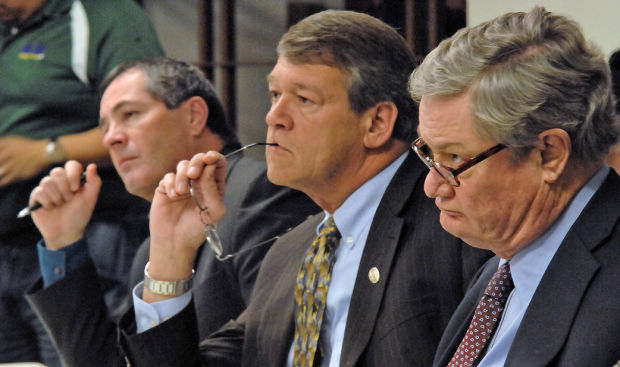
North Dakota Industrial Commission members, from right, Governor Jack Dalrymple, Attorney General Wayne Stenehjem and Agriculture Commissioner Doug Goehring listen as Director of Mineral Resources Lynn Helms explains an oil company proposal to drill in the vicinity Killdeer Mountain at a meeting on 1-24 afternoon. The state industrial commission heard of a proposal from Loren Jepson who is request to allow drilling near his property on Killdeer Mountain as well as opposition to the drilling.

Oil Drilling Near Killdeer Mountains

Oil Drilling Near Killdeer Mountains | Video
Jennifer Joas | 1/24/2013 

More and more oil wells keep popping up across the North Dakota landscape. But some landowners say the state should be protecting its most sacred areas, such as the Killdeer Mountains. They expressed their concerns to the Industrial Commission, but there may not be a solution.

It started nearly three months ago, when Hess first presented its case for putting a spacing unit near the Killdeer Mountains and the Killdeer Battlefield. Since then, landowners and alliance groups have expressed concern over drilling in that area.

"What we are asking you is to really look at where you do have powerful influence, and that is on the lands controlled by the state. And especially with this area which is so precious," said Sand.

Landowners say the spacing unit is too close to their homes, wildlife habitat and cultural artifacts. They would prefer if Hess moved it farther away, and drilled a longer distance. But the state says that is just not possible.

"The technology simply does not exist. It has not ever been done. There is no technology to drill four mile long laterals and to keep them in zone and to produce the wells," said Lynn Helms, Department of Mineral Resources Director. 

Helms says he looked into six other alternatives but he feels the one being proposed has the least impact to wildlife and people. He says if the state decides to do nothing, more than three million barrels of oil will be wasted, which equals about $250 million. But landowners say leaving the oil untouched for the time being is not wasting it.

"The oil is not going anywhere. I do not know why we have to rush to put wells down and extract. Why can we not wait 40, 50 years for the technology to improve?" said Dakota Goodhouse.

"What is the rush? The rush means quick decisions, unplanned decisions and unplanned impacts," said Theodora Birdbear.

"Do we have a price on the impact on tourism? Do we have a price on the impact on scientific research, and all the species you`ll be impacting? I do not see that ever in a budget anywhere. But I always see the cost of oil," said Anne Marguerite.

Helms also suggested placing stipulations on the case to minimize impacts to the roads, the artifacts and to provide better oversight by the State Historical Society.

The Industrial Commission voted to approve the recommended order, and added another stipulation for Hess to do everything possible to reduce flaring.
http://www.kfyrtv.com/Video_News.asp?news=61663