Thursday, December 26, 2013

DSU’s Stoxen Library to host “Civil War 150 Traveling Exhibition” Dec. 30-Jan. 27

DSU’s Stoxen Library to host “Civil War 150 Traveling Exhibition” Dec. 30-Jan. 27

Shanna Shervheim, interim associate director of communications, 701-483-2595
The American Civil War was the bloodiest in U.S. history, taking the lives of 1.5 million people and tearing the country in two. Experience the conflict through the eyes of major political figures, soldiers, families and freedmen at the “Civil War 150 Traveling Exhibition” at Dickinson State University’s Stoxen Library Dec. 30-Jan. 27.
A grand opening reception for this nationally acclaimed exhibition will be held at the library on Monday, Jan. 6 from 3-7 p.m. During the reception, Civil War era refreshments will be served including standard military fare hard tack. The public is invited to view the exhibition at any time during its month-long residency: weekdays from 8:30 a.m.-4:30 p.m. (Stoxen Library is closed New Year’s Day.)
The Civil War was one of the most transformative periods in U.S. history. After long-simmering sectional tensions led to seven slaveholding states seceding, the ensuing political strife gave way to war in April 1861. Through letters, personal accounts, and images, the exhibition portrays how people grappled with the end of slavery, the nature of democracy and citizenship, the human toll of war, and the role of a president during wartime.
“This wonderful exhibition has material that will appeal to both long-time Civil War buffs and to people just now learning about the war,” said Dr. Jim McWilliams, professor of English and co-coordinator of the exhibition. “I especially hope that teachers will schedule field trips with their students to tour the exhibition.
“Civil War 150” is a traveling panel exhibition that was developed by the Gilder Lehrman Institute of American History in partnership with The Library of America and made possible through a grant from the National Endowment for the Humanities. Stoxen Library, a winner of this competitive, prestigious grant, is one of only 50 sites nationwide and the only site in North Dakota selected to host the exhibition.
“We are very excited to have been chosen as the North Dakota site to host this exhibition,” said Rita Ennen, director of the Stoxen Library and co-coordinator of the exhibition. “The use of primary source documents, such as letters and photographs, conveys an intimate feeling as we experience the war through the eyes and ears of those who lived it.”
In addition to the “Civil War 150” exhibition, library guests also can peruse displays of items from Stoxen’s collection of Civil War materials, which includes an impressive collection donated by the estate of historian James D. MacNair, as well as the Civil War era Army artifacts in the Aleck Dvirnak collection.
To further explore the Civil War era, a series of events will be held at DSU during the month of January. All events are free and open to the public.
  • Jan. 6, 3-7 p.m., Stoxen Library, exhibition grand opening hosted by Stoxen Library Director Rita Ennen. Refreshments will be served.
  • Jan. 15. 7 p.m., Beck Auditorium, Klinefelter Hall. Professor of English Dr. Jim McWilliams will give a presentation about the roles two famous writers played in the Civil War entitled “Mark Twain & Ambrose Bierce in the Civil War.”
  • Jan. 22, 12 noon, Stoxen Library. The DSU History Society members will give a presentation about their trip to Gettysburg.
  • Jan. 22, 7 p.m., Beck Auditorium, Klinefelter Hall. Assistant Professor of History Dr. Frank Varney will give a lecture about the impact of the war on American society entitled “The American Civil War: Defining a Nation.”
  • Jan. 28, 7 p.m., Beck Auditorium. Assistant Professor of Music Dr. Jimmy Leach will lead the DSU music faculty in a recital entitled “Spirituals, Ballads, and Patriotic Music from the Civil War.”
  • Jan. 29, Beck Auditorium, Klinefelter Hall. Dr. Varney will host a screening of the documentary “Love and Valor: One Couple’s Intimate War Letters.”
“We hope that through the exhibition and related programming, visitors will explore the meaning of the Civil War in new and more personal ways,” Ennen said.
For more information about the exhibit or its associated programming, contact Rita Ennen at (701) 483-2883 or Jim McWilliams at (701) 483-2145.

Thursday, December 19, 2013

Industrial Commission considers new rules to protect areas of "extraordinary significance"

Industrial Commission considers new rules to protect areas of "extraordinary significance"


The state Industrial Commission is looking at proposed new rules dealing with oil activity in certain areas of North Dakota.
Attorney General Wayne Stenehjem has proposed the rules – to cover drilling in what he called places of extraordinary significance – such as the Killdeer Mountain Battlefield, the Little Missouri Grasslands and the Elkhorn Ranch. Stenehjem told his Industrial Commission colleagues – this will NOT prohibit oil exploration in those areas – but it asks the companies to have a “mitigation plan.”
The state Industrial Commission is looking at proposed new rules dealing with oil activity in certain areas of North Dakota.
Attorney General Wayne Stenehjem has proposed the rules – to cover drilling in what he called places of extraordinary significance – such as the Killdeer Mountain Battlefield, the Little Missouri Grasslands and the Elkhorn Ranch. Stenehjem told his Industrial Commission colleagues – this will not prohibit oil exploration in those areas – but it asks the companies to have a “mitigation plan.”
"What are they going to do in those areas to provide for a reduction -- as much as possible -- of any impact?" Stenehjem told his colleagues.
The proposed rules also allows for more public comment before wells are drilled in those sensitive areas.
"This process gives everybody a right to a say, but it doesn't give everybody a right to their way," said Stenehjem.
Gov. Jack Dalrymple chairs the Industrial Commission. He says to this point, he thinks the Commission has done a good job of being sensitive to those areas.
"I think you do point out a flaw in the process," Dalrymple told Stenehjem. "The lack of a formalized way to gather public input is probably correct.
"It's a good start," said Jim Fuglie. The fomer state Democratic NPL party chairman has been critical of plans to drill near the Killdeer Mountains and near Bullion Butte in Billings County. Fuglie says it appears the Industrial Commission will be more attuned to concerns raised by residents in those impacted areas.
"If someone looked at every one of the 3000 drilling permits issued in 2013, to see if there's one in some wildlife habitat, where the wellsite could be moved a half mile to allow mule deer a place to make love and create more mule deer," said Fuglie. "That's the kind of scrutiny that has not happened."
Meanwhile, a spokesman for the oil industry says while the industry agrees with many of the new rules, it has concerns about balancing public input with rights of private landowners and mineral rights holders.
"I happen to live in Bismarck, and my back yard is close to a theatre and a little park," said North Dakota Petroleum Council President Ron Ness. "I put a chain link fence up there. Should someone have been able to tell me the chain link fence really doesn't fit?"
The Commission will be holding another meeting to see if it wants to adopt Stenehjem’s proposal. If it does – it would also have to go through the Legislature’s Administrative Rules committee before final adoption.

Credit Dave Thompson / Prairie Public
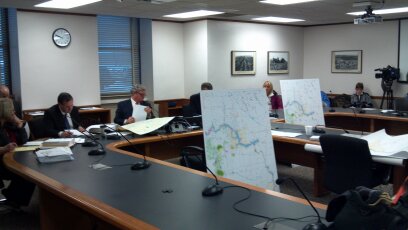
Members of the North Dakota Industrial Commission briefed on proposed new rules for oil drilling in areas of "extraordinary significance."

Wednesday, December 18, 2013

Industrial Commission of ND Meeting on Places of Extraordinary Signficance

AGENDA
Industrial Commission of North Dakota
 including a Joint Meeting with the 
Housing Finance Agency Advisory Board 
Thursday, December 19, 2013
9:00 a.m. – Harvest Room & Governor's Conference Room
I.   North Dakota Department of Mineral Resources Business – Lynn Helms
A.  Consideration of Order 23935  issued in Case 15773 in response to a petition for 
reconsideration of Order 18028  (Attachment 1)
B.  Consideration of orders for the following cases which were heard on October 24 and
November 20, 2013 : (Attachment 1a)
Case 20800, Order 23106 – request for two 1440 acre spacing units
Case 21158, Order 23462 - request for use of double wall open tank receptacles for storage of
produced water – exception to NDAC §43-02-03-19.3
Case 21219, Order 23523 – creation of two 1280 acre spacing units
C.  Consideration of Case 20853, Order 23159 heard on October 1, 2013 - Amendments to
Administrative Rules (Attachment 2)
D.  Consideration of proposed rules relating to general drilling permit consideration; designation 
of places of extraordinary significance; and additional requirements for permitting in places of 
extraordinary significance.  – Attorney General Stenehjem (Attachment 3)
E.  Other North Dakota Department of Mineral Resources business

(approximately 10:05 a.m.)
II.  North Dakota Pipeline Authority Business – Justin Kringstad
A.   Presentation of 2013 Annual Report and Financial Report (Attachments 4 & 5) B.   Other North
Dakota Pipeline Authority business

*******Meeting will break to relocate to the Governor’s Conference Room*******

(approximately 10:10 a.m.)
III.  Lignite Research, Development & Marketing Program Business – Jason Bohrer, Mike Jones
(by phone)
A.  Presentation of comments being presented on December 19, 2013 to the Minnesota Public Utilities
Commission in the Matter of the Investigation into Environmental and Socioeconomic Costs Under
Minn. Stat. §216B.2422, subd.3.– Attorney General Stenehjem (Attachment 6)
B.  Presentation of Lignite Research Fund Financial Report– Karlene Fine (Attachment 7)

Industrial Commission Meeting
Page 2
December 19, 2013

C.  Consideration of the Lignite Research Council’s recommendations regarding the following Grant
Round 76 applications:
1.   “Investigating the Use of Fly Ash and Nanomaterials for Sustainable Concrete Infrastructure”;
Submitted by University of North Dakota Department of Civil Engineering; Request for $14,559 (Small
Research); Total Project Costs $60,642; Project Duration 14 months (Attachment 8)
2.   “Continuation of Underground Coal Gasification Study in Western North Dakota”; Submitted by
University of North Dakota Institute for Energy Studies; Request for $299,958 (Demonstration);
Total Project Costs $719,958; Project Duration 18 months (Attachment 9)
3.   “Alstom’s Chemical Looping Combustion Technology with CO2 Capture for
North Dakota Lignite Utilization”; Submitted by Alstom Power Inc.; Request for
$500,000 (Demonstration); Total Project Costs $10,489,821; Project Duration 36 months (Attachment
10)

*****Consideration of a motion to close the Industrial Commission meeting pursuant to North Dakota
Century Code 54-17.5-06 to consider the following agenda item regarding a project that has
previously been determined to be confidential******

D.  Update by American Lignite Energy, LLC regarding their project “Lignite Vision 21
Project Coal-to-Liquids Plant McLean County, North Dakota” – Carroll Dewing, David
Straley


**********Meeting returns to open session*******

E.  Consideration of a request from American Lignite Energy, LLC for an amendment to Contract
FY06-LVII-148 amending the “Decision Date” from December 31, 2013 to December 31, 2014 (Attachment
11)
F.  Other Lignite Research, Development & Marketing Program business

IV.  North Dakota Transmission Authority – Mike Jones
A. Presentation of 2013 Transmission Authority Annual Report and Financial Report
(Attachments 15 & 16)
B. Other Transmission Authority business

(approximately 10:45 a.m.)
V.  North Dakota State Mill Business – Vance Taylor (by phone)
A.  Consideration of request to increase FY 2014 Capital Project – K-Mill Capacity Increase – Phase
3 by $800,000 bringing total project costs to $3,900,000. (Attachment 17)
B.  Other North Dakota State Mill business

(approximately 10:55 a.m.)
VI. Bank of North Dakota Business – Eric Hardmeyer
A.   Presentation of the following audits – Eide Bailly

Industrial Commission Meeting
Page 3
December 19, 2013

1.   PACE Audit – June 30, 2013 (Attachment 18)
2.   Ag PACE Audit – June 30, 2013 (Attachment 19)
3.   Rebuilders Loan Program Audit – June 30, 2013 (Attachment 20)
B.  Consideration of amendments to School Eligibility for DEAL Loan Policy
(Attachment 21)
C.  Consideration of amendments to Funds Management Policy (Attachment 22)
D.  Presentation of nonconfidential Bank of North Dakota Advisory Board October 17, 2013 meeting
minutes (Attachment 23)
E.  Other Bank of North Dakota business

******Meeting closed pursuant to N.D.C.C. 6-09-35 to discuss items listed below on the agenda under
Bank of North Dakota Confidential Business********

VII.  Bank of North Dakota Confidential Business – Eric Hardmeyer
A.  Consideration of Bank of North Dakota loan application (Attachment 24) B.  Problem Loan Update
C.  Presentation of confidential Bank of North Dakota Advisory Board October 17, 2013 meeting
minutes (Attachment 25)
D.  Other Bank of North Dakota confidential (as defined under N.D.C.C. 6-09-35) business

***************Meeting returns to open session******************

(approximately 11:40 a.m.)
VIII. Western Area Water Supply Authority business – Jaret Wirtz (by phone) & Karlene Fine A.
Presentation of Western Area Water Supply Authority monthly report (Attachment 26) B.  Other WAWSA
business

(approximately 11:50 a.m.)
IX.   Joint meeting with the North Dakota Housing Finance Agency Advisory Board on North
Dakota Housing Finance Agency Business – Jolene Kline
A.  Presentation of the Housing Finance Agency Advisory Board Vice-Chairman’s Annual
Report – Ron Jordan (Attachment 27)
B.  Presentation of the Housing Finance Agency’s Fiscal Year 2013 Audit – Brady Martz
(Attachment 28 )
C.  Presentation of the Housing Incentive Fund Fiscal Year 2013 Audit – Brady Martz
(Attachment 29)
D.  Consideration of the Housing Finance Agency Advisory Board’s recommendation for the Agency to
enter into a contract with Fannie Mae to offer the HFA Preferred Risk Sharing Program (Attachment
30)
E.  Consideration of the Housing Finance Agency Advisory Board’s recommendation to rescind the
Reserve Funds Order Policy (Attachment 31)
F.  Consideration of the Housing Finance Agency Advisory Board’s recommendation to approve the
Agency’s SWAP Management and Executive Policy (Attachment 32)
Industrial Commission Meeting
Page 4
December 19, 2013
G.  Consideration of the Home Mortgage Finance Program 2014 General Authorization
Resolution (Attachment 33)
H.  Consideration of the North Dakota Industrial Commission’s Executive Director recommendation
regarding the appointment of the North Dakota Housing Finance Agency Executive Director (Attachment
34)
I.   Other North Dakota Housing Finance Agency business

(approximately 12:20 p.m.)
X.  North Dakota Outdoor Heritage Fund business – Karlene Fine
A.  Update on Outdoor Heritage Fund Grant Round applications. (Attachment 35) B.  Other Outdoor
Heritage Fund business

(approximately 12:25 p.m.)
XI. Administrative Business – Karlene Fine
A.  Consideration of transfers from Industrial Commission agencies/programs for the
2013-2015 biennium for the Administrative Office operations (Attachment 36)
B.  Other Industrial Commission Administrative business

XII. Other Industrial Commission Business/Adjournment

Bold items require Industrial Commission action
Any person who requires an auxiliary aid or service must contact or notify the Industrial
Commission
Office at 328-3722 at least three (3) working days prior to the scheduled meeting.

http://www.nd.gov/ndic/ic-press/magenda.pdf

Thursday, November 14, 2013

Battle Lines vs. Power Lines: Part 3

Battle Lines vs. Power Lines: Part 3

Posted: Nov 14, 2013 6:40 PM CSTUpdated: Nov 14, 2013 9:08 PM CST

KMOT.COM - Minot, ND - News, Weather, Sports

It was here on the Killdeer Battlefield that a U.S. military force commanded by General Alfred Sully attacked several groups of the Dakota, Nakota, and Lakota Sioux nations. And it is also the site Professor Tom Isern has chosen for a historical study.

"Killdeer Mountain was chosen because it is the climactic engagement of the Dakota War. I commonly refer to it as the Gettysburg of the plains. Not because of the numbers involved but because of the fate of the sovereign nations are in the battles in this fall day in 1864," says Isern.

Isern says that the growth in North Dakota prompted the study.

"With the rapid pace of development in Western North Dakota there's a sense that we should get a handle on what went down on this battlefield. It's money to figure out what happened where."

The study will be conducted in two parts, starting with looking at historical documents.

"Mostly it's a historical study with historical documents that go all the way back to commanders reports and enlisted men's diaries. And at some point we will ask permission to go on the ground as much as we can and look around. And try and figure out what people would have done in this place given what we know from the documents," says Isern. 

Isern says he thinks that Basin Electric and the historical study can co-exist, but it could mean moving the transmission line. 

"I don't question the need for energy infrastructure in Western North Dakota. The route now specified runs right across the most historic site in all of North America. And that might be a matter of debate I believe it is. But I'm not sure it needs to go exactly in that place."


http://www.kmot.com/story/23974882/battle-lines-vs-power-lines-part-3

Wednesday, November 13, 2013

Battle Lines vs. Power Lines: Part 2

Battle Lines vs. Power Lines: Part 2
Posted: Nov 13, 2013 11:03 AM CSTUpdated: Nov 13, 2013 3:22 PM CST

KMOT.COM - Minot, ND - News, Weather, Sports

As Northwest North Dakota  continues to grow and develop the need for electricity grows exponentially.

"Having the transmission line like this gives us the ability to provide stability to the transmission system that is already in place," says Daryl Hill, Basin Electric.

By 2025 Basin Electric predicts its power demand will increase by 30 percent. To help meet the demand Basin electric has proposed a transmission line that they're calling the "AVS to Neset line," in a place which is lacking infrastructure.

"The infrastructure needs all three. The generation but still you have to have the ability to bring in other sources and that's what this transmission line will do. By bringing power from an existing resource that has the capacity up to an area that needs that," says Hill.
Now the 200-mile proposed transmission line will run 18 miles west of Killdeer up to Williston but it will all start here at the Antelope Valley Station.

Antelope Valley Station outside of Beulah is a coal burning power plant, with the ability and power to add another transmission line. Something Basin Electric has been planning for years.

"We started analyzing this transmission line in 2011. The study application was submitted in
early 2013, 2 years after we had already announced this and well after public announcements had been made about the line in terms of environmental impact statement," says Hill.
But now Professor Tom Isern at North Dakota state University announced a historic study of the Killdeer Battlefield that could interfere with 8 miles of Basin's proposed corridor.

"Really we didn't hear about that study until virtually days before the Public Service Commission had their public meetings scheduled on this line," says Hill.

Despite being surprised by the study, Basin Electric says it has already gained seven and a half miles of easements of the eight that are within the study area, which Public Service Commissioner Brian Kalk says is a positive.

"Every project we do whether it's a power line or a pipeline one of the questions I always ask percentage of easements they have. We aren't involved in easements at all but it's a nice way to gauge of how it is being received in the community," says Kalk.

And Hill says Basin Electric is more than willing to work with the various state and federal agencies involved in the permitting process.

"We have an obligation to serve. We have an obligation to get power up into that area so that the whole system doesn't go dark. Because nobody wins if northwest north Dakota is without power," says Hill.
The PSC has completed their hearings, but are still waiting on information that they requested from the Game and Fish Department, and the Historical society. Basin electric is also waiting on information from the Federal Government on an environmental impact study, and are hoping to start construction in 2014. 

Tuesday, November 12, 2013

Battle Lines vs Power Lines: Part 1

Battle Lines vs Power Lines: Part 1

Posted: Nov 12, 2013 5:43 PM CSTUpdated: Nov 12, 2013 5:43 PM CST
KUMV.COM - Williston, ND - News, Weather, Sports

It was here on July 28, 1864, that a U.S. military force commanded by General Alfred Sully attacked several groups of the Dakota, Nakota, and Lakota Sioux nations camped at this location. The number of fatalities is not known, but the loss to Native American culture is profound.

It was once the site of a historic battle. But today, the Killdeer battlefield is at the center of a new dispute.

As western North Dakota continues to grow, the need for electricity grows with it. Basin Electric Co-Op has proposals to build a transmission line that will run through an area where some of the fighting took place.

"For generations the Dvirnacks have kept this site," says Craig Dvirnack.

Craig and Rhonda Dvirnack's ranch surround the 1 acre historical site that belongs to the state of North Dakota.

"When my grandfather sold his wheat crop in the fall of 1928 he made a down payment on this ranch. And so it's been in our family since...since then," says Craig.

Over the years the couple have extensively researched the battles that took place along the proposed route.

"It will go through an area where there was fighting that did take place, but it does not go through the state historic site," says Craig.

"We are on section 33, so you can see that the transmission line is over a half mile south of us," says Rhonda. 
Rhonda and Craig believe that energy development can coexist with this historic site.

"I'm for it. You have the communities along the way that this transmission line would supply power to. How can you tell these communities that you can't build a hospital, you can't build a school, you can't build houses or apartments to grow for all the influx of people. How can you tell them you can't provide power for them?" says Craig.

While the Dvirnacks support the transmission line the couple questions a historical study awarded to Professor Tom Isern at the NDSU. Their land, the historic site and the proposed transmission line are part of Isern's study area.

"We don't know what his intentions are to this day because nobody has explained to the landowners out here the ramifications if this study would happen," says Craig.

The Dvirnacks say they have not been contacted by any member of the research team, and that they will continue to support preserving the historic site, and the construction of the transmission line.

http://www.kumv.com/story/23950157/transmissin-killdeer

Monday, November 11, 2013

ND officials debate need for list of ‘special places’ to be protected

Published November 11, 2013, 10:41 AM

ND officials debate need for list of ‘special places’ to be protected

FARGO, N.D. — A divided North Dakota Industrial Commission soon will decide whether to designate special places subject to development restrictions to protect them from oil drilling or other development.
By: Patrick Springer, Forum News Service
FARGO, N.D. — A divided North Dakota Industrial Commission soon will decide whether to designate special places subject to development restrictions to protect them from oil drilling or other development.

The commission has discussed the possibility of a list of special sites for half a year, and Gov. Jack Dalrymple proposed more than 40 candidate sites on a tour in late August.

Spots include Little Missouri State Park, where Dalrymple made his announcement, Killdeer Mountain, roadless areas in the Little Missouri National Grasslands and the units of Theodore Roosevelt National Park.

Attorney General Wayne Stenehjem also is compiling a list and formulating a policy for “extraordinary places” that also will include the Little Missouri River as it winds through the western North Dakota Badlands.

Stenehjem planned to present his proposal to his fellow Industrial Commission members at the group’s Nov. 18 meeting, but he told The Forum of Fargo-Moorhead’s editorial board last week that it’s more likely that he will do so at the meeting slated for Dec. 19.

“There’s a lot of beautiful areas out there,” Stenehjem said, adding that the commission, which approves drilling permits, already imposes restrictions to try to minimize impacts.

However, he said, a formal procedure has been lacking, with decisions made on a case-by-case basis as the commission reviews drilling permits.

“I’m working on a plan I can present,” with requirements spelled out in administrative rules that, if passed under emergency provisions, could take effect early next year, Stenehjem said.

Public hearings and opportunities for public comment are included in the rule-making process, he said. Some conservation advocates have complained that the process of designating special places so far has not been open to public participation.

Restrictions could include requiring wells to be located a long distance from special places – say, two miles – or requiring pipe placement to avoid flaring natural gas, he said.

“Just a whole lot of things can be done,” Stenehjem said.

The attorney general said he has met informally with representatives of the oil industry as well as conservation groups to ensure support for his proposal.

In reviewing permits, the commission must balance the rights of mineral holders against the duty to protect landscapes, and must let the public be heard, Stenehjem said.

Devising a list of special places and procedures for developing around the sites would provide the industry greater clarity about how to proceed in certain areas, he said.

“I think industry might be happy if they know what that area is,” he added.

As an example, he said the commission required XTO to drill a well two miles from the Elkhorn Ranch, a unit of Theodore Roosevelt National Park and a ranch home of the great conservation president, instead of nearby, as the company originally proposed.

“I knew we were never going to put a well on the Elkhorn Ranch,” Stenehjem said.

Besides the Elkhorn Ranch and Little Missouri River, Stenehjem mentioned Killdeer Mountain and battlefield sites, Bullion Butte, and the national and state parks.

The lists Dalrymple and Stenehjem are contemplating appear to have a lot of overlaps, but the third member of the industrial commission, Agriculture Commissioner Doug Goehring, said he is not in favor of such lists.

“When you talk about special places, I would consider all of North Dakota special,” Goehring said. “It’s going to be case by case because every site’s unique,” he added, referring to the review of drilling permits.

“I would say we’re doing a good job of doing that, making sure there are stipulations that it’s developed in a responsible manner,” Goehring said, including reclamation requirements for wells and tank clusters.

Goehring has compiled a list of permits that have been issued with stipulations or were rejected, including a running total of the number of acres involved.

Over the past year, 2,741 permits were submitted to the Industrial Commission involving development of about 3.5 million mineral acres.

Of that total, 268 permits involved an “area of concern,” totaling about 343,000 acres.

Thirty-five of those permits, involving 45,000 acres, were rejected. Well placements on another 49 permits encompassing 63,000 acres were modified due to concerns about topography, erosion, watershed or soils.

In a final category, 463 permits affecting 560,000 mineral acres were approved with stipulations, such as shallow aquifer or surface water protection.

“Beauty is in the eye of the beholder,” Goehring said. “A lot of things I think are beautiful, people pooh-pooh,” including farm fields.

Goehring said he is concerned that if certain places are designated as special, restrictions on agricultural land eventually could result.

“Because there’s people there who would like to see us go back to buffalo commons,” Goehring said, referring to a prediction 20 years ago that vast tracts of the Great Plains would revert to sprawling rangeland for wild game, including buffalo.
- See more at: http://www.prairiebizmag.com/event/article/id/16715/group/Economic%20Development/#sthash.mhLxLGM9.dpuf