
Showing posts with label Senate Bill 2341. Show all posts
Showing posts with label Senate Bill 2341. Show all posts
Friday, February 15, 2013
SB 2341 Failed
SECOND READING OF SENATE BILL
SB 2341: A BILL for an Act to provide for an appropriation to the state historical society for archeological surveys.
ROLL CALL
The question being on the final passage of the amended bill, which has been read, and has committee recommendation of DO PASS, the roll was called and there were 16 YEAS, 31 NAYS, 0 EXCUSED, 0 ABSENT AND NOT VOTING.
YEAS: Andrist; Axness; Dotzenrod; Grabinger; Heckaman; Marcellais; Mathern; Miller; Murphy; Nelson; Oehlke; Robinson; Schneider; Sinner; Triplett; Warner
NAYS: Anderson; Armstrong; Berry; Bowman; Burckhard; Campbell; Carlisle; Cook; Dever; Erbele; Flakoll; Grindberg; Hogue; Holmberg; Kilzer; Klein; Krebsbach; Laffen; Larsen; Lee, G.; Lee, J.; Luick; Lyson; O'Connell; Poolman; Schaible; Sitte; Sorvaag; Unruh; Wanzek; Wardner
Engrossed SB 2341 failed.
http://www.legis.nd.gov/assembly/63-2013/journals/sr-dailyjnl-29.pdf#pagemode=bookmarks&Page418

Tuesday, February 12, 2013
Committee trims bill to survey Killdeer Mountain battlefield site
Committee trims bill to survey Killdeer Mountain battlefield site
A bill that would have appropriated $250,000 to survey the Killdeer Mountains battlefield area has been scaled back considerably.
Monday, the Senate Government and Veterans Affairs Committee voted 6-1 to approve the bill, but cut the funding to $4,999.
The bill, Senate Bill 2341, had its first hearing on Friday before the committee and had broad support from the archaeological community and some area landowners.
They want the area studied before more oil exploration is done in the area which is considered by some to be the most significant battle site between U.S. forces and American Indians in terms of people involved and land area.
The bill drew opposition from one landowner, Bryan Dvirnak, whose family has owned part of the battlefield since 1928. He said no one had contacted his family regarding the survey.
Another amendment to the bill stipulates the State Historical Society of North Dakota must have written permission from landowners, defining the scope and conditions of the survey and access to the land.
Artifacts discovered and preservation of the site would be up to the landowner under the amendment.
http://bismarcktribune.com/news/local/govt-and-politics/committee-trims-bill-to-survey-killdeer-mountain-battlefield-site/article_481f7a88-7564-11e2-bc97-0019bb2963f4.html
http://bismarcktribune.com/news/local/govt-and-politics/committee-trims-bill-to-survey-killdeer-mountain-battlefield-site/article_481f7a88-7564-11e2-bc97-0019bb2963f4.html
SB 2341: CONSIDERATION OF AMENDMENTS
CONSIDERATION OF AMENDMENTS
SB 2341: SEN. SCHAIBLE (Government and Veterans Affairs Committee) MOVED that
the amendments be adopted and then be placed on the Eleventh order with DO PASS,
which motion prevailed on a voice vote.
http://www.legis.nd.gov/assembly/63-2013/journals/sr-dailyjnl-26.pdf#pagemode=bookmarks&Page325
Monday, February 11, 2013
SB 2341 was recommended DO PASS by Government and Veterans Affairs Committee
REPORT OF STANDING COMMITTEE
SB 2341: Government and Veterans Affairs Committee (Sen. Dever, Chairman)
recommends AMENDMENTS AS FOLLOWS and when so amended, recommends
DO PASS (6 YEAS, 1 NAYS, 0 ABSENT AND NOT VOTING). SB 2341 was placed
on the Sixth order on the calendar.
Page 1, line 6, replace "$250,000" with "$4,999"
Page 1, line 7, after "conducting" insert "historical, cultural, and"
Page 1, line 11, after the period insert "The state historical society may not survey the private property without a written agreement with the private landowner which defines the scope of the survey and the conditions of access to the property and provides any artifacts discovered are the property of the landowner. Following the survey, any preservation of the site is in the discretion of the landowner."
Renumber accordingly
http://www.legis.nd.gov/assembly/63-2013/journals/sr-dailyjnl-25.pdf#pagemode=bookmarks&Page320
Friday, February 8, 2013
How Best To Preserve The Story Of The Killdeer Mountain Conflict
FRIDAY, FEBRUARY 8, 2013
How Best To Preserve The Story Of The Killdeer Mountain Conflict

An image of a soldier engaged in hand-to-hand combat with a warrior. The image is engraved upon the elevator doors on the ground floor and main floor.

The study area of the Killdeer Mountain Conflict within the purple boundary.
The citizenry gathered in little groups here and there to introduce themselves and exchange greetings. It seemed like a fellowship of near universal concerns that brought everyone together, and life is like that. Sometimes it takes one thing to bring people together who might not have met in another situation.


An alarming amount of existing wells and proposed wells within the Killdeer Mountain Conflict area.
The hearing was scheduled at 2:00 PM CST and the fellowship exchanged the hall of polished stone and brass for the quiet cell of the Missouri River Room. A coterie of archaeologists clustered together in one corner, the tribal representatives quietly moved themselves to a corner close to the front, and historians scattered amongst the throng. Chit chat grew to a loud buzz, and though the Government and Veteran Affairs Committee was delayed an hour the motley collection of citizens didn't seem to grow impatient.
This is North Dakota , and sometimes things happen when they’re scheduled to, and other times things happen when they should. Farmers might call it natural time, Indians would agree.


Senator Triplett explains that next year marks the 150th anniversary of the Killdeer Mountain Conflict. "Its an opportunity for the state to reflect on the tragedy that shaped our statehood and include the story that has been under represented these long years," said Triplett, or something like that - my pen could not move fast enough.
The good people who made up the committee apologized for their unexpected delay and things quickly got started when Chairman Dever (Dist. 32, Bismarck) brought the gavel down with great ceremony and authority. The hearing was to hear Senate Bill 2341, a proposal by senators on either end of the political spectrum, introduced by Sen. Wardner (Dist. 37, Dickinson) but the voice of the bill was provided by Senator Triplett (Dist. 18, Grand Forks ).
Senate Bill 2341 proposed to appropriate $250,000 to do an archaeological and historical survey of the Killdeer Mountain


Paaverud maintained an impeccable composure of respect for the committee as he endorsed the Heritage Center's support of the bill.
Mr. Merlan Paaverud and Ms. Fern Swenson represented the interests of the State Historical Society of North Dakota and voiced the SHSND’s endorsement of this bill. Ms. Swenson offered that the Killdeer Mountain


Dr. Isern addresses the committee. He said his piece in about five minutes or less and gave some handouts with points explaining the nature of heritage preservation.
Dr. Tom Isern, Director of the Institute for RegionalStudies, rendered a concise and wonderful explanation of the intrinsic value of Killdeer Mountain


An immaculately groomed Aaron Barth (looking at the camera) visited with Mr. Jepson of Killdeer.
A few concerned citizens took to offering their support of this bill. Mr. Aaron Barth, founding writer of The Edge Of The Village, shared the need to survey and catalogue the Killdeer Mountain


Without waver or hesitation, Young shared a resolution regarding sacred places from the National Congress of American Indians.
Ms. Waště'Wiŋ Young, Standing Rock Tribal Historic Preservation Officer, took the stand and pointedly stated that “the Indian voice has yet to be heard.” Young boldly shared with the committee a resolution adopted by the National Congress of American Indians in October of 2012 regarding the protection and preservation of sacred places. She read the whole thing, expressed her office’s support of Senate Bill 2341, and quietly departed.


Bravebull-Allard representing Standing Rock Tourism supports this bill.
Ms. LaDonna Bravebull-Allard, Director of Standing RockTourism, shared her lineage going back to survivors who were at Killdeer Mountain Killdeer Mountain was a sacred site, not just to the Dakota and Lakota people, but the Mandan , Hidatsa, Chippewa and Assiniboine . With practiced confidence of a story-teller she shared that the site was where Sun Dreamer ascended Killdeer Mountain

St. John spoke with dignified authority, less than two minutes, and left many of the committee nodding their heads in approval of her gracious support.

Sand called for the state to move carefully and deliberately to preserve North Dakota's heritage sites.
Mr. Rob Sand, a representative of the Killdeer MountainAlliance, a tall gentleman with the gait of a lifelong rancher took to the podium briefly and passionately encouraged oil development to wait. Sand offered the support of the Killdeer Mountain Alliance in favor of the bill.


Rothaus, self-described hard-boiled skeptic, put the bill on a scale but explained the overwhelming need to preserve as much of the story of Killdeer as possible and endorsed the bill.
Dr. Richard Rothaus, founder and director of TrefoilCultural and Natural, drove like a mad man from his office in Sauk Rapids, MN to render cold and succinct explanation of the Killdeer Mountain conflict’s standing in US military history as one of the largest, if not the single largest, Indian-White conflict in the west and why North Dakota needs to preserve as much of the conflict site and stories as possible. A former university professor, Rothaus came across brutally blunt but also exceptionally honest. He also endorsed his support of the bill.

Dvirnak proudly wore a Fighting Sioux windbreaker to the hearing. He forgot to bring one for me.
Lastly, Mr. Bryan Dvirnak, a lifelong rancher on family-owned and managed land at Killdeer Mountain Canada . The Dvirnaks have graciously allowed traditional ceremonies and prayers to be conducted on their land throughout the years.
Dvirnak, regardless of his family’s openness to the American Indian presence on his family’s land, managed to convey his open skepticism of the bill. “What will the [archaeological] study do?” he wondered aloud. Dvirnak conveyed his disillusionment with the bill, the sharpest point of his argument manifested itself in his question about what the bill would mandate him to do on his own land.
The bill doesn’t mandate anyone to do anything on their own private land. In fact, the bill mandates that the archaeologists who conduct the investigation must acquire the permissions of all landowners in the study and core areas of the Killdeer Mountain
Mr. Dvirnak and his family have the best intentions, a family mission taken to heart, passed down from father to sons, to preserve the heritage of Killdeer Mountain
They did this because there’s a story that needs to be preserved and shared, and that’s something that everyone who testified can agree.
Thursday, February 7, 2013
$250,000 requested to study Killdeer Mountain
Published February 07, 2013, 11:27 PM
$250,000 requested to study Killdeer Mountain
BISMARCK – A proposal in the state Senate seeks to provide $250,000 to do an archaeological study within the Battle of Killdeer Mountain study area, in part due to the encroachment of oil development.
By: Forum News Service, INFORUM
Wednesday, February 6, 2013
Time To Survey The Killdeer Conflict Site
WEDNESDAY, FEBRUARY 6, 2013
Time To Survey The Killdeer Conflict Site
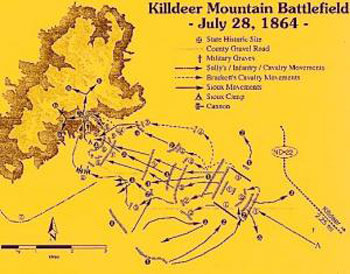
A map of General Sully's movements as he advanced and then fired on the Yanktonai Dakota and Hunkpapa Lakota at the Killdeer Mountain conflict site.
I received the following from Ms. Connie Triplett, ND State Senator, District 18, Grand Forks, ND.
SB 2341 proposes to appropriate $250,000 to do an archaeological survey within the Killdeer Mountain battlefield study area. I am one of the co-sponsors of this bill. I am looking for people who may be willing and able to testify on the bill.
The bill will come up for hearing on Thursday, February 7, 2013 at 2:00 p.m. before the Senate Government & Veteran's Affairs Committee in the Missouri River Room.

"The 8th Minn Infantry Mounted in the Battle of Ta Ha Kouty" by Carl Ludwig Boeckmann
I have two reasons for supporting this bill. First, the State is intending to celebrate its 125th anniversary in 2014. That year is also the 150th anniversary of the incident on Killdeer Mountain (battle or massacre, depending on one's perspective). It seems to me that the State has an obligation to understand what happened there, as much as can be ascertained at this late date, and to make an effort to join with the affected tribes in commemorate the incident before it celebrates statehood yet again. I think it's important that people understand how the land we now call North Dakota came to be available for settlement and to acknowledge that it involved displacing others who had called the area home for a long time. I believe that knowledge and acknowledgment can bring understanding and healing.

About fifty North Dakota citizens, native and non-native, shown here showed up for the public hearing held by the ND Industrial Commission in January.
The second reason for supporting an archaeological study at this point in time is the imminent encroachment of oil development within the study area. There are already a number of wells on Killdeer Mountain and another has recently been sited on the edge of the study area defined by an earlier American Battlefield Protection study.
Whether the study proposed by this bill actually happens will depend in large part on the willingness of private landowners to allow archaeologists on their land, of course. I am hoping that at least some of them may be more willing to have this study completed now than they might have been in the past because of their own concerns about the encroachment of oil development. (Rob, please forward this email to other landowners on the mountain, especially those within the defined study area.)

From the south looking north to one part of Killdeer Mountain, compare to Carl Ludwig Boeckman's painting of Sully's advance above. Boeckman stayed remarkably true to the landscape.
In a recent ND Industrial Commission hearing, Gov. Dalrymple said it would be nice if there was some way that the members of the Industrial Commission could know in advance where the sensitive areas are. This bill would provide that information, at least for this one historically significant area (and it's good wildlife habitat, too!)
I understand that there may be hesitation on the part of tribal members to be supportive of this initiative for fear of disrupting tribal burial sites or other sacred sites. It is my hope that this work, if approved by the legislature, will be done in a manner that is sensitive to those concerns. Your presence at the hearing can help to define or limit the study as appropriate.

Medicine Hole is at the top of the eastern half of the Killdeer Mountain plateau. Women and children made a mad scramble up the plateau to escape artillery rounds.
I also know that Tom Isern has an application pending with the American Battlefield Protection Program to better define the exterior boundaries of the area. It is my hope that the work supported by this bill would be done in close concert with Tom's work, if his grant applicaton is approved.
I would respectfully request that everyone who receives this email forward it promptly to others who may be interested in attending the hearing. If you know for sure that you will be able to attend, please let me know.
Thank you.
Connie Triplett
ND State Senator
District 18, Grand Forks
Thursday, January 24, 2013
SENATE BILL NO. 2341
13.0827.01000
Sixty-third
Legislative Assembly
of North Dakota
Introduced by
Senators Wardner, Andrist, Triplett
Representatives N. Johnson, Onstad, Oversen
A BILL for an Act to provide for an appropriation to the state historical society for archeological
surveys.
BE IT ENACTED BY THE LEGISLATIVE ASSEMBLY OF NORTH DAKOTA:
SECTION 1. APPROPRIATION - STATE HISTORICAL SOCIETY - ARCHEOLOGICAL
SURVEYS. There is appropriated out of any moneys in the general fund in the state treasury,
not otherwise appropriated, the sum of $250,000, or so much of the sum as may be necessary,
to the state historical society for the purpose of conducting archeological surveys in the Killdeer
battlefield study area, for the biennium beginning July 1, 2013, and ending June 30, 2015. The
state historical society shall reduce its expenditures relating to the general fund appropriations
provided under this section by any grant funds received by the state historical society for the
purposes identified in this section.
http://www.legis.nd.gov/assembly/63-2013/documents/13-0827-01000.pdf?20130210173423
Subscribe to:
Posts (Atom)